• Skip to main content
  • Skip to secondary menu
  • Skip to footer

Ice Skating Passion

There is not better feeling...

  • BEGINNER
  • FIGURE SKATING / DANCE
  • ICE HOCKEY
  • SPEED SKATING
  • ABOUT
  • STORE

Articles by Claire

12 best figure skating protective gear (pads) for training

Last updated on April 24, 2021

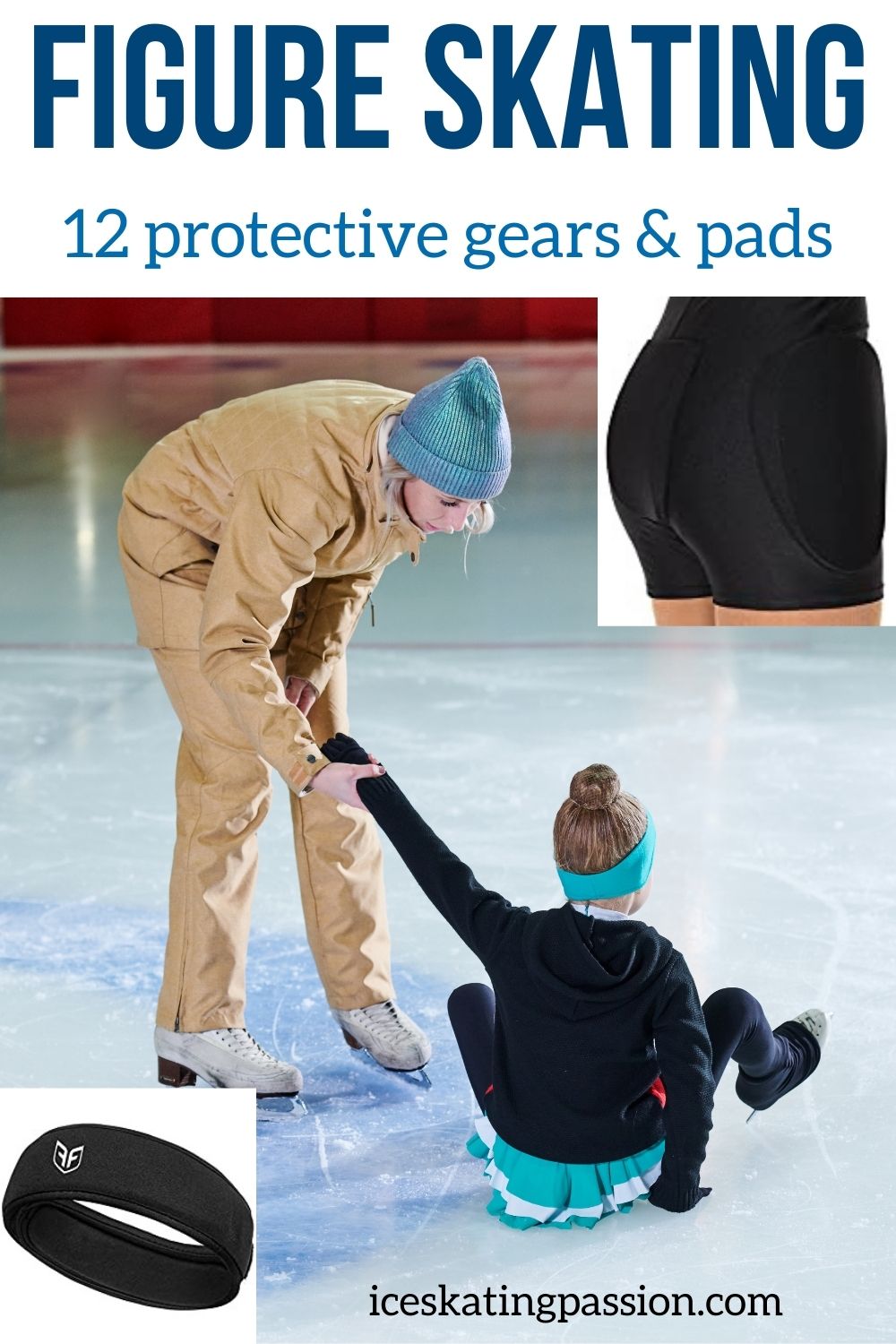
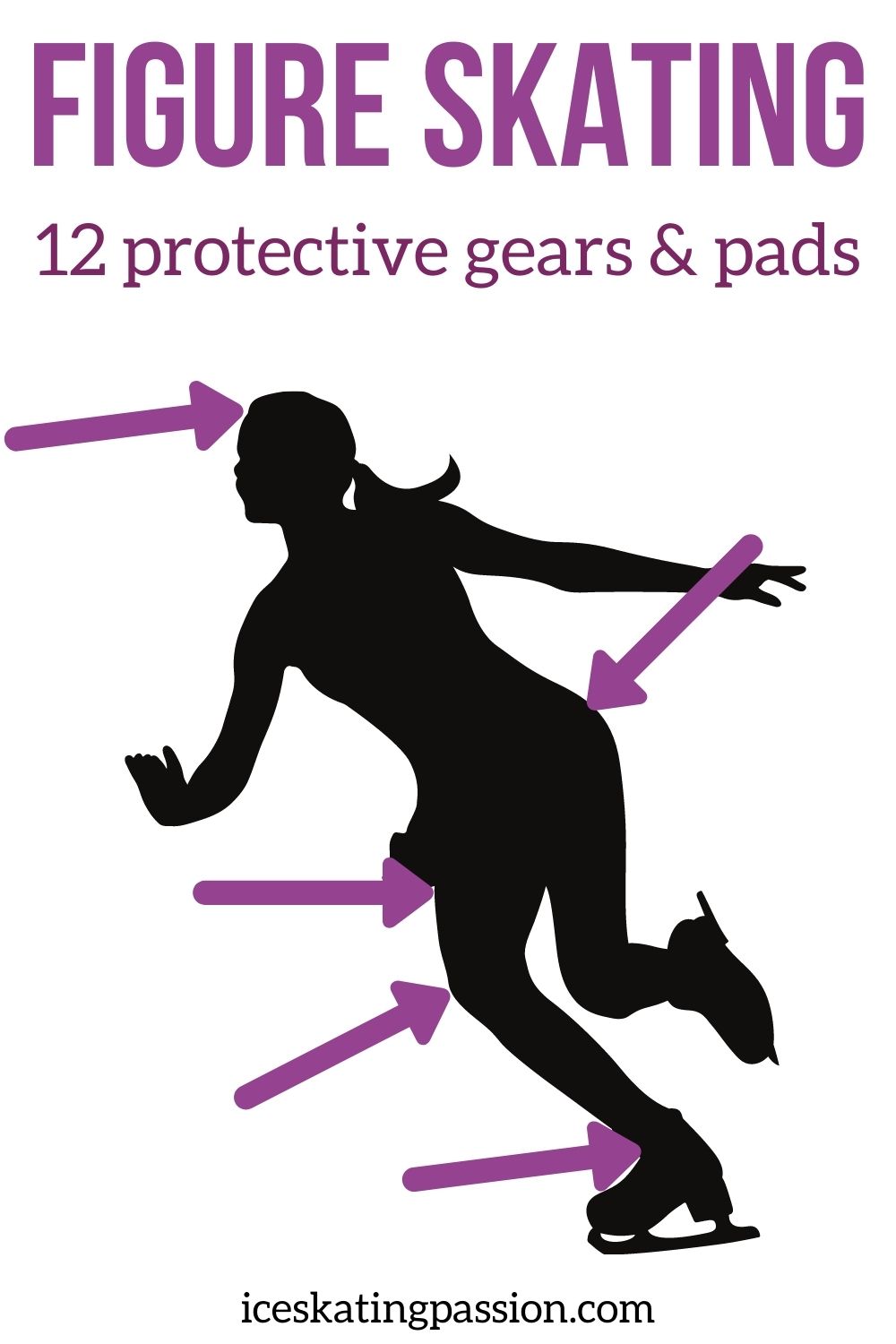
Practicing new skills? That's fun, but it can also be somewhat painful because of repetitive falls. Below are 12 figure skating protective gears to consider wearing for practice : padded shorts, crash pads, headband, sleeves... to protect the most impacted body parts. Skate safe!
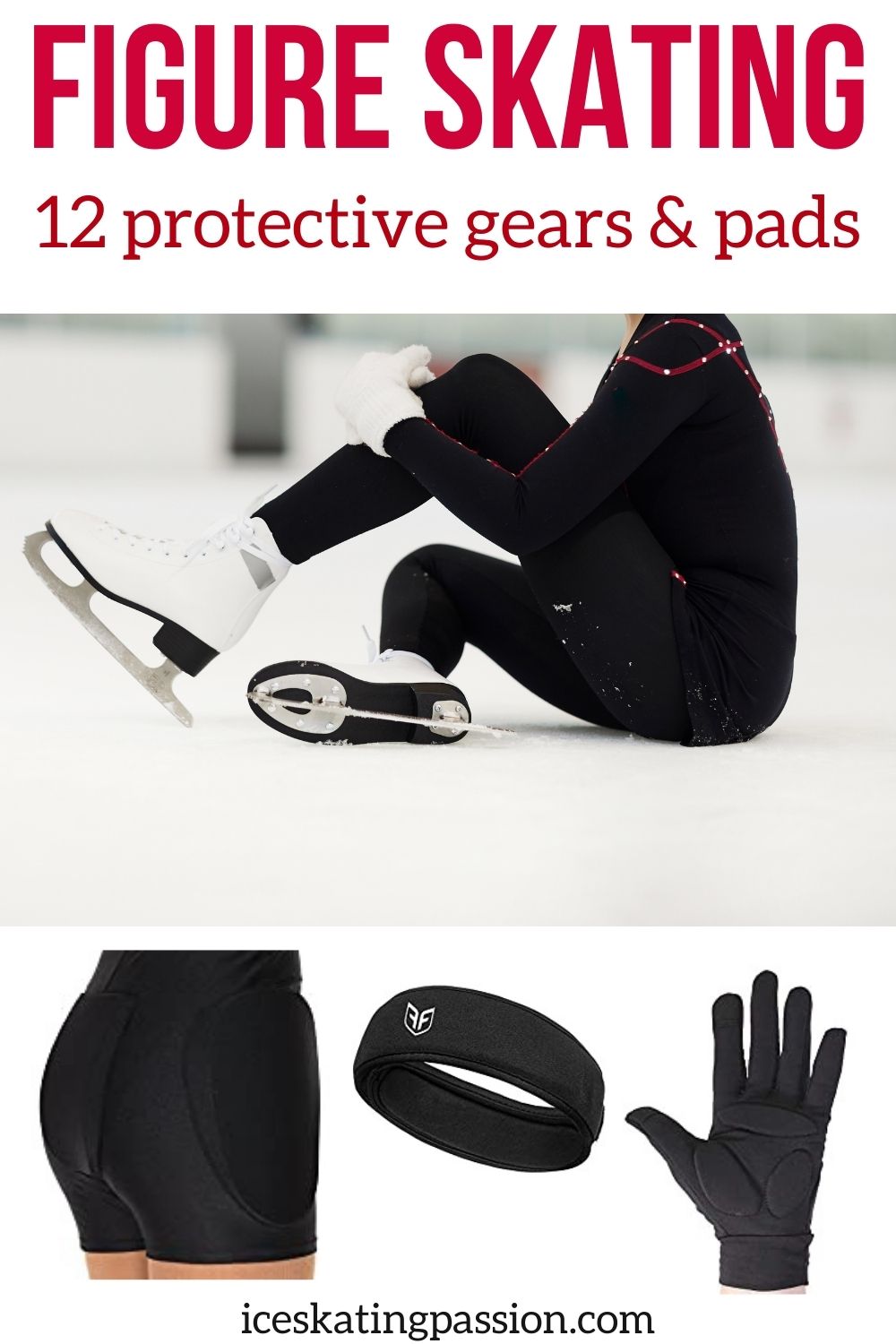
best ice skating protective gear Pin2

Table of Contents
Why wear figure skating protective gear?
Practice - Figure skating padded shorts and clothes
Figure skating crash pads to protect body parts
Figure skater feet protective equipment
Beginner kid - Ice skating protective gear (helmets and pads)
Other essential ways to protect the skater from injury

This article contains affiliate links. If you purchase using my link, I get a commission at no extra cost to you (learn more).


Why wear figure skating protective gear?

Ice skating offers lots of health and mental benefits. But it is also balancing on a thin blade on ice... falls are bound to happen.

Like a dancer, a figure skater pays attention to his/her looks, even at practice.
But considering the quantity of falls as you try mastering a new skill to reach a new level, I say let's forget vanity and wear protective gear over your training clothes!

Products have been developed specially to protect body parts that are the most at risk for figure skaters:

  • the hips
  • the tailbone
  • the knees
  • the hands
  • the feet
  • the head

Protection will help against:

  • serious injury
  • long-term issues due to repetitive injury (even small ones)
  • counter-performance because of pain

Of course, protections does not mean you don't need good warm-up and focus. But they complement them.

Below are some of the best pads and and sleeves to protect yourself or your kid.

Figure skating fall
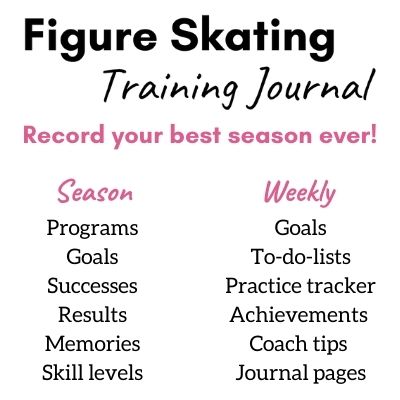
Figure Skating Training journal Ad 1a
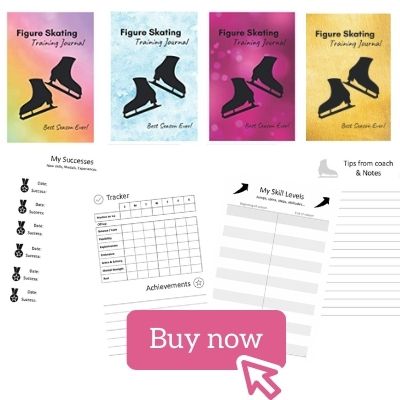
Figure Skating Training journal Ad 2

Practice - Figure skating padded shorts and clothes

Let start with some of the classic padded clothes that will protect you or your kid during the practice of skills.

Figure skating padded shorts / butt pads

Wearing a padded lycra short above tights or leggings when practicing new jumps is ideal.
It does not look sexy, agreed.
But the skater feels so much better after the training session!
It reduces the bruises and potential micro-fissure on the hip and tail bones.

See the 2 colors / Read reviews

Get them / Read reviews

Figure skating padded gloves

You often use your hands to stop a fall. They hit hard on the ice.
A solution to protect them are the padded gloves.
They keep your hands warm (like regular ice skating gloves) while protecting the most vulnerable areas of the palm with 3 pads.
Plus the material is water resistant to avoid having wet hands during practice.

See colors / Read reviews

Figure skating knee pads

When jumping, falls will mostly be on the side and butt, impacting the hips and tailbone. Hence the short above.
But for other moves, you may end up on your knees.
The following are made for volley-ball players who fall hard on their knees many times during a match. So, if you are practicing a special skill (or your kid) and noticing a repetitive fall on the knees, make sure to wear padded knee sleeves.

Get them on Amazon

Forcefield protective headband

In any sport, one of the scariest injuries is a head one. It is rare in figure skating, but it can happen.
A helmet might be going overboard at a certain level, but it is still a good idea to increase protection.
This headband has been developed to reduce the impact on hard surfaces.
This could give peace of mind to the skater, and to the mums and dads.
Plus, it is breathable so that you don't feel discomfort when sweating. 

See the colors Forcefield headgear / read reviews


Figure skating crash pads to protect body parts

Next stops are the pads you can place inside your clothes to protect those areas.

  • Some prefer the clothes I listed above because they hold themselves up and come back in place whatever movements you make.
  • Some prefer the figure skating pads below, because they have control on where to place them

Figure skating hip pads

The most commonly used figure skating crash pads are the hip pads.
Made of rubber, they impact the force during the contact with the ice.
They are thick, but this is how they protect you!
Don't forget to buy one for each hip 🙂

Get it on Amazon

Figure skating Tail pad

Next are the tailbone pads. It is a same concept except it is a butt pad.
Tail bone injuries are painful and last quite long, because you are always impacting the bone when you sit. So, it is a very important area to protect.
Made of rubber, it impacts the force during the contact with the ice.
It is thick, but this is how it protects you!

Get it on Amazon

Next, we look at the protective gears to protect your feet.

Figure Skating gift banner Zazzle 3
ice skating accessory gift banner
Figure skating notebook gift star ice pink
Figure skating leggings gift born to skate
Figure skating blade towel synchro blue arabesque gift
Personalize & Buy

Figure skater feet protective equipment

We have been talking about falling a lot.
But even if you are just skating, there is an area of your body that gets many demands: the feet.
Let's face it: figure skating boots are not made to be comfortable. They try to be as much as possible, but you still need something that holds your feet and ankle well so that you can balance on a thin blade.

Friction and pressure can create bunions, tendonitis, cuts, blisters and other feet injuries.
Let's have a look at what you can wear to protect them.

Ankle and Malleolar sleeves and gel discs

For friction, some of the worst areas are the Malleolar (since they protrude) and the ankle (at the limit of the boot).
I was lucky to not have malleolar problems, but I still have a strong memory of a friend training with me with a horrible problem there that just would not go away
It that case, a gel disc or a sleeve, can help widen the area of friction and limit the injury.

The ankle, I can relate on. Especially at the beginning of the season, when you have had a break from wearing figure skates or when you are breaking new boots. Those sleeves will protect ankles from rubbing, friction, and chafing from stiff boots.

Get it on Amazon

Get it on Amazon

Get it on Amazon

Achille Heel Pads

Another area of the feet that can get injured is the Achille heel.
Before you buy these, make sure the issue is not coming from skates that are too big. The best protection you can have for your feet are skates with a proper fit.
However, if fit is not the problem, a sleeve can reduce the friction and protect the area around the Achille Heel.
However, if you have tendonitis, make sure to discuss with a doctor and rest your feet.

Get it on Amazon

Toes & Bunions

The toes of figure skaters are not as bad as the toes of ballerinas. After all, you are taking balance from your whole foot, not just your toes.
However, friction and bad socks can have an impact on the toe area with blisters and bunions.
Gels and sleeves can help protect or spread the friction area to limit injuries.

Get toe separator on Amazon

Get a bunion correction and relieve sleeve

And find out more ways to protect yourself at the end of the article.


Beginner kid - Ice skating protective gear (helmets and pads)

Now, if you are on this article for a beginner kid, the options above (except for the butt pads), may be too advanced.
At the beginning, many parents opt for:

  • a helmet
  • knee pads
  • elbow pads
  • wrist protections

See colors / Get the kit on Amazon


Other essential ways to protect the skater from injury

However, wearing protective gear is not the only way to protect yourself or your kid from injury.
Other elements of figure skating training are essentials to reduce the risk of falls and reduce the injury in case of falling:

  • if the muscles are flexible
  • if the muscles can hold you 
  • if the tendons are strong enough

The 4 main activities are:

  • Warming-up before training - for your muscles and tendons to be ready before any high impact training, it is essential to warm them up progressively. Work out a plan with a coach
  • Stretching after practice - skaters are normally good with warm-up but stretching after if often overlooked. Skaters are in a hurry to get home or get to school, it is thought that there is not enough time. But stretching your body after intense practice is essential for the health of your muscles and tendons
  • Building core strength outside the rink - time on the ice is limited, therefore it is essential to build the skater's body outside of ice practice - especially working on core muscles that will allow better control over jumps and spins, thus reducing falls. check out my article with what to work on off the ice and my other article on the best off ice training equipment.
  • Finally, a good balanced diet will keep your muscles, tendons and bones in good condition and more prepared to handle brutal shocks
Figure Skating gift banner Zazzle 3
ice skating accessory gift banner
Figure Skate blade Towel Axel in life pink glam
Ice skating pillow - Pink Born to ice skate
Ice skating notebook live on edge blue silver
Personalize & Buy

Share0
Tweet0
Pin0

You might also be interested in:
Best figure skating spinner (2022)

Top 10 Figure skating off-ice training equipment

9 tips for figure skating moms and dads (competition level)

best figure skating crash pads Pin1
best figure skating protective gear Pin1

Figure skating music (tips to choose + ideas to find yours)

Last updated on April 24, 2021

Ready for a new program? But here is the question: what will you skate on? Below are my tips to choose the best figure skating song for you as well as rules and suggestions to find figure skating music ideas.

best figure skating music ideas Pin1

Table of Contents
Rules about short and long program musics
Best figure skating songs for you - 7 criteria to consider
Where to find figure skating music ideas
Editing your figure skating program music 
Most popular figure skating musics

This article contains affiliate links. If you purchase using my link, I get a commission at no extra cost to you (learn more).


Rules about short and long program musics

A big change in rules in 2014

Since its Olympic debuts at the 1908 Summer London Olympic Games, figure skating rules have only allowed non lyrical music to be used.
However a huge change happened recently in 2014 when the ISU (International Skating Union) announced that lyrics would be allowed to play during competitions.

Opinions have varied. Some skaters stick with tradition while other embrace the opportunities it brings.
Personally, I would not skate to music with lyrics because it would be too difficult not to sing along 🙂

The current rules about music for figure skating programs

Basically, the current rules that you should have in mind regarding music are the following (from the ISU regulation, but flowing to National regulations):

  • All program must be skated to music (rule 243)
  • All competitors shall furnish competition music of excellent format on CD or in any other approved format (rule 243)
  • Competitors must provide a back-up drive for each program (rule 243)
  • The certified length of the music for each program must be submitted at the time of registration (rule 243)
  • Regarding ISU championships, titles of music and name of composer shall be submitted (Rule 379)
  • The program shall be skated in harmony with the music chosen by the Competitor. The music is chosen by each Competitor, vocal music with lyrics is permitted; (Rule 611, 612, 620, 621, 709, 710)
Figure skating program music

Scoring related to music 

In the description of the components to establish the Program component score, it includes:

  • "Involvement of the Skater/Pair/Couple physically, emotionally and intellectually as they deliver the intent of the music and composition"
  • Expression of the music’s character / feeling and rhythm, when clearly identifiable
  • Use of finesse to reflect the details and nuances of the music
  • Relationship between the Skaters reflecting the character and rhythm of the music
  • And extra for ice dance: "Skating primarily to the rhythmic beat for Rhythm Dance and keeping a good balance between skating to the beat and melody in the Free Dance"

Special ice dance rules

Rules are more stringent with regards to ice dance, because of the dancing element of the performance. 

  • Regarding the Rhythm dance (rule 709) - must have an audible rhythmic beat, and must be in accordance with the designated rhythm selected for the season
  • Regarding the free dance (rules 710) - must have an audible rhythmic beat, must have at least one change of tempo and expression, edited to create an "interesting, colorful, entertaining dance program with different moods or a building effect"

Can you choose any music? How about the licensing and artist rights?

You don't have to care about that. Just pick a music you like.

The test and competitions are live events, no permission is required.
The rinks and/or clubs are responsible to purchasing a license that allows them to diffuse all music in a public forum (different licenses for free and paying events). It covers the copyright laws about "the right of public performance".
The license includes reporting criteria.

Discover over 70 million songs on Amazon Music Unlimited - Get your free trial!

Amazon music unlimited

Best figure skating songs for you - 7 criteria to consider

#1 - Impact of the music on the skater

The most important thing, is that the skater 

  • enjoys the beat
  • is transported by the music

Nobody enjoys watching someone who does not enjoy the music and is just moving in rhythm to it.
If you can conjure emotion as you listen to it and you can put it into your performance, then it will show and make a difference to your score.

The skaters should close their eyes or start dancing imagining a potential choreography. Do movements come naturally?

#2 - Lyrics or no lyrics?

So, as I wrote earlier, lyrics are now allowed (though maybe some local regulations might still be behind, check the rules in your country).
That does not mean you have to have lyrics.

Pros of staying with instrumental figure skating music:

  • The audience focuses more on the dance without lyrics. Otherwise, the listening takes the audience away from the watching
  • Without lyrics you are free to interpret the music. However, with a song, the story has already been written and you have to interpret that story, otherwise it would look strange

Pros of skating to lyrics:

  • Can be a crowd pleaser, chanting along your song
  • Increase the number of options for music

However, if you choose a song with lyrics, don't be too literal. Don't skate only to the words but listen more in depth to the nuances in the music.

#3 - Age / skill suitability

The capacity to trigger emotion in the skater should always be the priority in my opinion.
However, within that, it is better to choose a music suitable for the skater's age.

  • You don't want to big of a gap between the intensity of the music and the emotional depth of a child - he/she will be over-powered by the music
  • And at the other end, you don't want an easy superficial music for a teen or young adult who can portray deeper emotions - the program will be boring

It must also be adapted to the skills of the skater:

  • Don't choose a very fast tempo if the skater is not quick in his/her movements - it should be adapted to the figure skating level
  • If his/her arabesques are beautiful, choose a piece with long notes to highlight them
  • ...
Figure skating music program

#4 - The judge age gap

This is a controversial criterion.
Should you take into account what should please judges, who are generally quite older than the skaters?

Some say yes, that it gives you an advantage, it creates empathy from the judges.
Some say no, a well interpreted program should be loved anyway by the judges.
But judges are only humans.

When I was skating competitively, I had a music style that really suited me and my skating style. I was really moved by Yiddish and tzigane musics. They transmit very powerful emotions. I have always connected to them (despite having no specific connection to those communities).
Just before my last season, a judge came to my parents and said she was tired of seeing me perform on those musics. That she did not enjoy them and that I should try something else.
So I went to a completely different style: Grease. It was a not a success. Many other judges told me it was not a good choice, despite the program being technically good. Part of it was because it was too simple for my age and part of it because I could not use my capacity to express strong emotion. So, I had to create another program for the season. Lesson learnt.

#5 - Choreography / story opportunity

Listen to the music and imagine the choreography.
Does it have changes and rhythms of moods that would create good choreographic moments that suit your skill.
Can you imagine specific moves you love fitting perfectly at a moment in the song?

Can you hear some discreet elements of the music that your moves could highlight? This would give depth to your performance.
Are there nuances behind the main tempo that you could interpret with part of your body? Again, this would give depth to your performance.

And does it tell a story to you?
Imagining a story can help display emotions better and adapt the choreography.

#6 - Edit-ability of the music

Another point that may be more difficult to consider when listening first to a music is the ability to edit it to the correct length.
Depending on the skater's level, programs last from 1min to 4min30. It can be a difficult trick to create such a short version.

For something easier to edit, choose a music with natural pauses, where the phrases or the lyrics stop or with distinct rhythm changes.

#7 - Don't copy

At high level, you don't want to create a program on a music that is the same as another iconic program e.g. the Ravel Bolero from Torvill and Dean.

At regional / national level, make sure you don't use the music a direct competitor used the season before. People will want to compare both of them, instead of totally focussing on your program. This is a natural reaction.

Other than that, it is normal to have cycle and see musics come back.
And above all, it is important to enjoy the music. So, this should always take precedence.

Note: keep your choice to yourself

If before the season, you already have ideas, only discuss it with your coach.
Don't share too much with other skaters, as people are quick to take the idea as if it is their own. Sometimes not even realizing they are "stealing" the idea. Friendships have been strained because of that.

Figure Skating Training journal Ad 1a
Figure Skating Training journal Ad 2

Where to find figure skating music ideas

OK. Now that you have all the criteria to keep in mind when listening to music, where should you find ideas... There is a lot of music out there!

Always keep a list

With phones nowadays, it is easy to take notes any time you want.
So, right now, open a list on yours called "figure skating ideas".
And any time throughout the year, as soon as you hear a music you / your kid enjoy, take note of it.
You can use an app like Shazam to learn the title and composer / singer.

Discuss with your coach

For younger children, the coach can be a great help, if there is a good relationship.
Coaches have seen many programs, they have a large database of music ideas. They can at least guide you / your child.
However from 9 or 10 years old onwards, the final choice should definitively come from the kid.

Just scroll music libraries

It has never been as easy as it is today. You have many programs offering millions of tracks of music.
For example you can try Amazon Music Unlimited - get your free trial!

Amazon music unlimited

Listen to radio stations you are not familiar with

If you always listen to the same radio station, you will hear the same music.
Just change the frequency and listen to what pops up.

Watch old / foreign skating programs

YouTube is full of skating program of all levels.
You can see archives of old programs or programs of national level skaters in other countries.
This can give you ideas.

Movie soundtracks / Broadway songs for figure skating

Watch older movies and older broadway play and pay attention to the soundtracks.
You can find beautiful musics that are often overlooked!

Find music experts

There are clubs and music schools or shops where group of music afficionados gather. Go ask them. 
Tell them what type of music and tempo you are looking for, and they will make you discover all kinds of music you never knew existed.

This is how I have found a few of my musics. Someone who had a passion for music and understood my style.

Figure Skating gift banner
Figure Skating gift banner Zazzle 3
Sticker ice skates pair figure skating rainbow
Figure skater notebook star on ice frozen blue
Ice skating mirror figure skates red silver
Personalize & Buy

Editing your figure skating program music 

Once the music or musics are chosen, it is time to edit and reduce to the program length.

Program lengths (US)

Below are the lengths to respect. Times must be respected plus or minus 10s.

  • Pre-Juvenile - Free = 2:00min
  • Juvenile - Free = 2:15min
  • Intermediate - short = 2:00min / Free = 2:30min
  • Novice - short = 2:30 min / Free = 3:30min (male); 3:00min (female); 3:30 (pair / dance); 3:00 (dance)
  • Junior - short = 2:40min; Rhythm (dance): 2:50min / Free = 4:00min (male); 3:30min (female); 4:00min (pair); 3:30 (dance)
  •  Senior - short = 2:40min; Rhythm (dance): 2:50min / Free = 4:30min (male); 4:00min (female); 4:30min (pair); 4:00 (dance)

How to edit

3 options to edit your music:

  • Normally all rink environments have someone used to editing the music - the coach, a former skater or relative... Ask your coach
  • Hire a professional music editor (company or solo) - I saw this website with someone who specializes in figure skating (but I can't recommend or not as I don't know him at all, I just noticed the website).
  • Learn to do it yourself - it is always fun to learn a new skill, and you can create exactly what you want - Free software such as Audacity, Ocenaudio or priced software such as Adobe Audition if you have the adobe suite of products...

Tips

  • Learn how to properly edit music - there are many tutorials on the Internet, take advantage on them!
  • Make sure the start of the music is loud enough not to be missed, but not so loud that it startles everyone
  • For more beginner skaters, a gradually increasing tempo can be a good idea, when possible (if the skater misses the beginning of a fast music, it can be hard to catch up
  • Some include a beep a second or two before the music start
  • Control how loud the music is, especially when changing song or tracks
  • Be really sure you do not exceed the rule for length - the limit is +/- 10 seconds, not one second more - don't think you can get away with it.
  • Avoid long silent sections (the judges may think there is an issue with the music)
  • Be careful with your transitions - make sure they blend well
  • Never forget your music for competitions - check out my competition checklists

Most popular figure skating musics

Popular songs are not a bad choice, especially for a beginner level.
Just be aware that someone else might have the same music as you during the competition.

However, as the skater get into more advanced levels, originality is better.

Classical / opera

  • Swan Lake 
  • Carmen
  • Phantom of the Opera
  • The Four Seasons
  • Nutcracker
  • Turandot
  • Moonlight Sonata
  • Scheherazade
  • Clair de Lune

Broadway / Movies

  • Moulin Rouge
  • The Sound of Music
  • Star Wars
  • Miss Saigon
  • Les Miserables
  • Clair de Lune.

Kids

  • Ghostbuster
  • Pink Panther
  • Beetlejuice
  • Frozen
  • Adams family
  • Mary Poppins
  • Wizard of Oz
  • more and more pop songs...
Figure Skating gift banner Zazzle 3
ice skating accessory gift banner
Figure Skate blade Towel Axel in life pink glam
Ice skating pillow - Pink Born to ice skate
Ice skating notebook live on edge blue silver
Personalize & Buy

Share0
Tweet0
Pin0

You might also be interested in:

Ice dancing vs Figure skating – 7 differences

All you need to plan an ice skating birthday party (ideas + tips)

9 Best ice skating bags in 2022 (figure skating) + how to choose

best figure skating songs Pin1
best ice skating music ideas Pin2

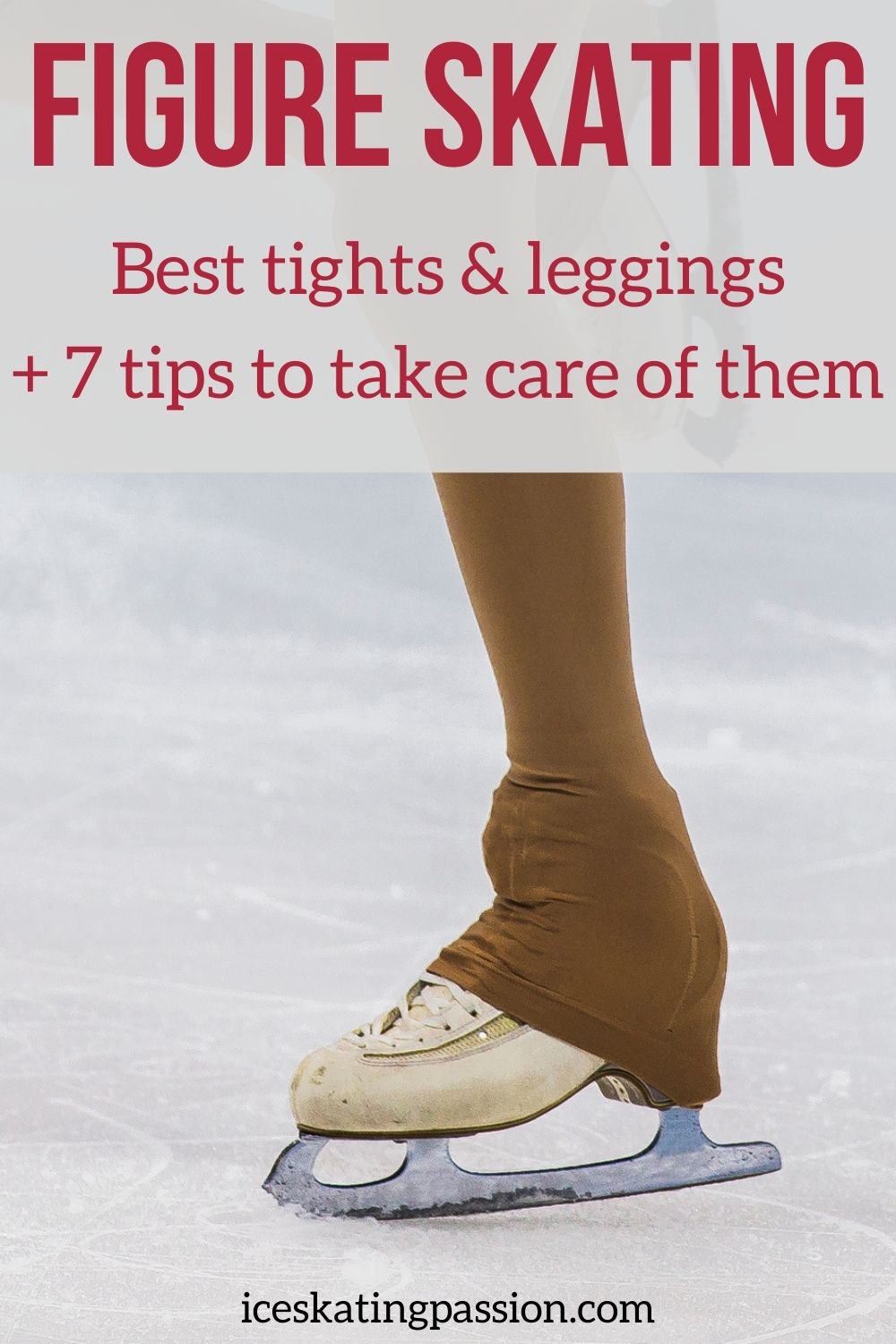
Best figure skating tights (+ leggings) – competition & practice

Last updated on April 24, 2021

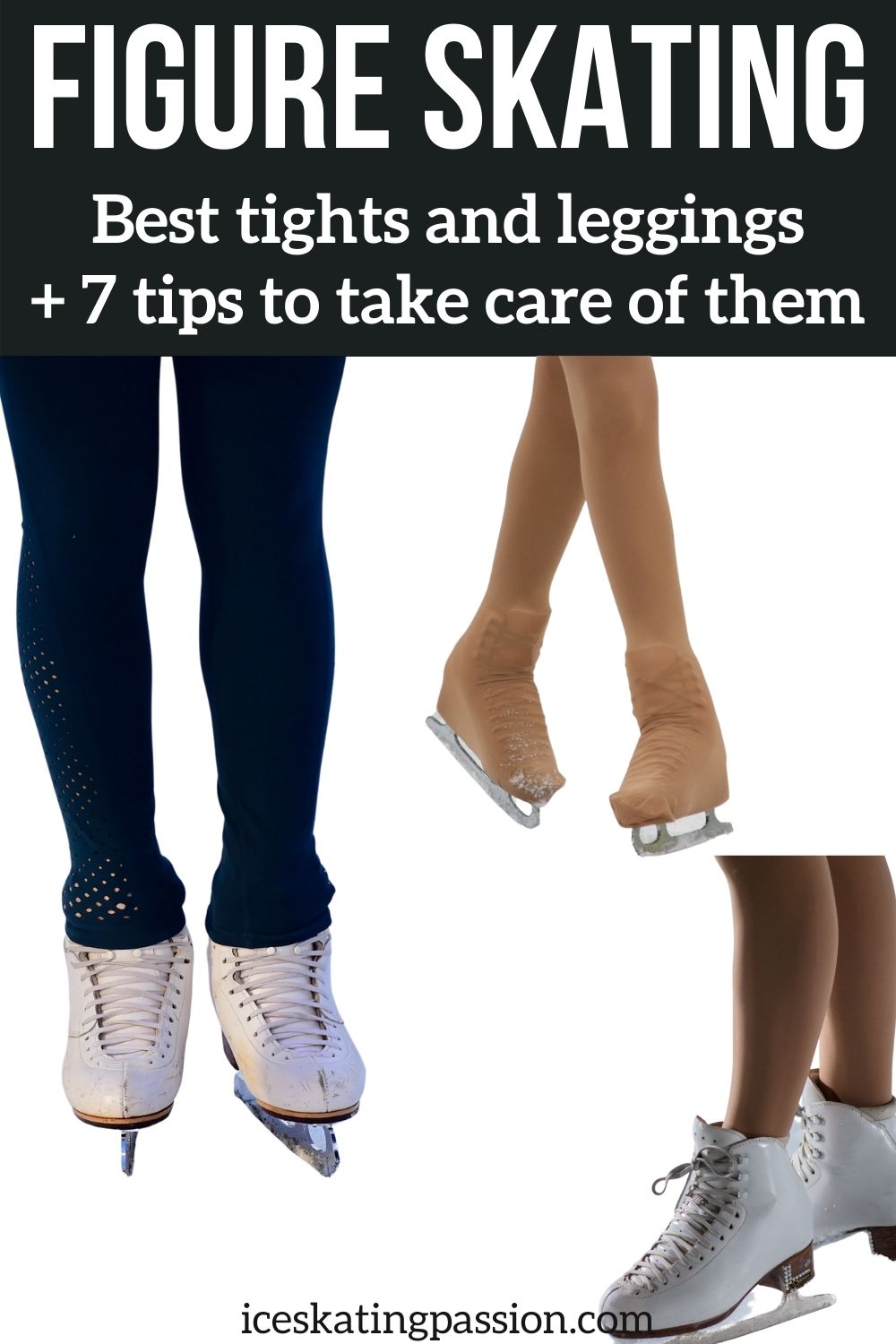
Let's discuss the criteria to choose the best figure skating tights or leggings for you: shape, material, color... For competition or practice, there is a large choice of ice skating tights and leggings. Below are my tips to help you choose the best ones for your needs, and how to take care of them.

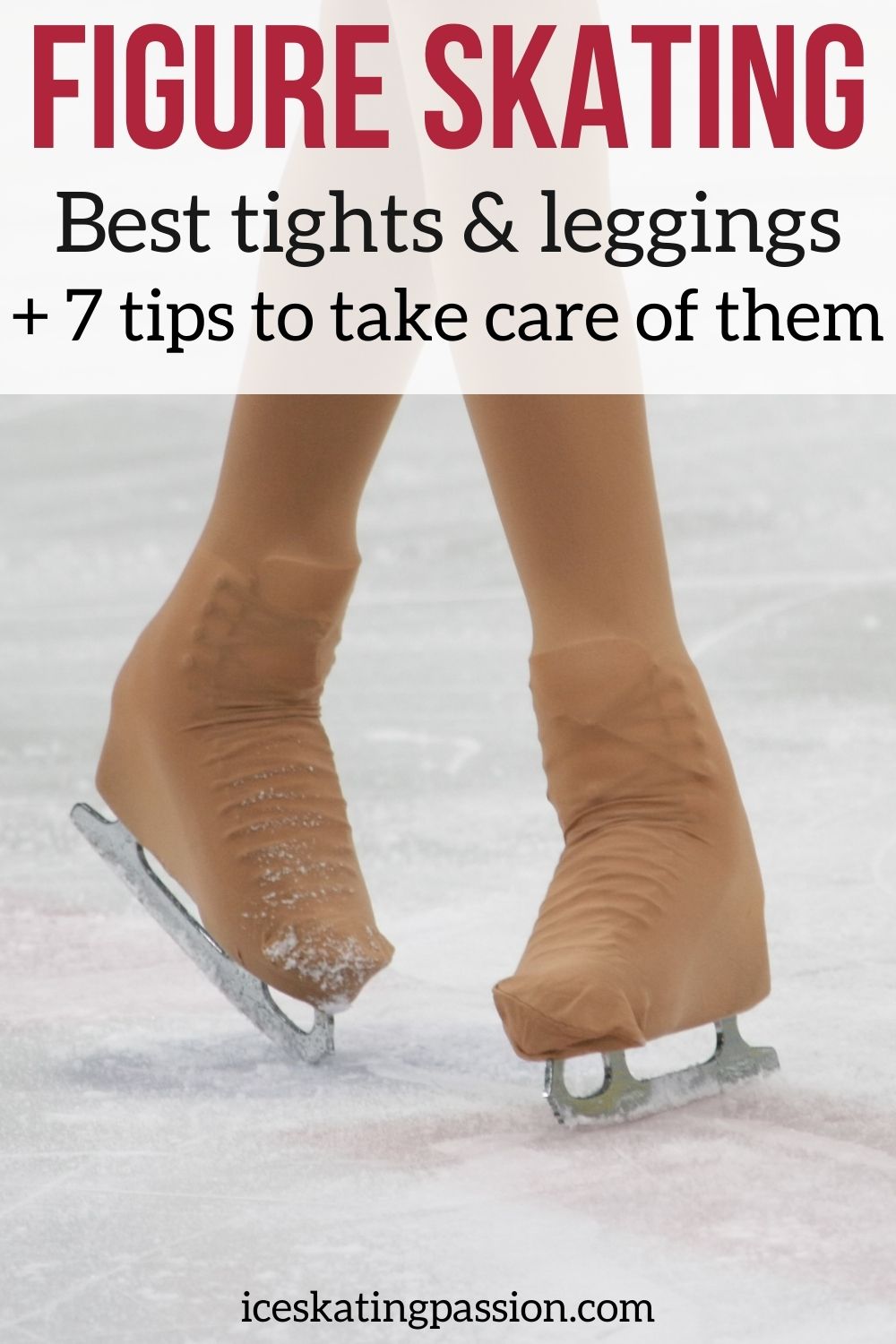
best ice skating tights leggings Pin1

Table of Contents
Best figure skating tights & leggings - competition & training
Why should you wear tights as a figure skater?
Criteria to choose ice skating tights
Best tights for figure skating competition
Best figure skater leggings for practice
6 Tips to take care of your tights

This article contains affiliate links. If you purchase using my link, I get a commission at no extra cost to you (learn more).


Best figure skating tights & leggings - competition & training

Tights and leggings are an essential part of the figure skater outfits. Let's have a look at the main criteria to consider and some of the top products.

Best figure skating tights for competition

The most important criteria to choose tights for competition are:

  • Texture and color - the aspect of the leg on the ice is often the most important aspect for competition - you want the legs to look beautiful
  • Overboot / footed - the other important aspect of your competition costume is the use of boot covers or not. Tights with over boot covers make legs look longer.
  • Comfortable - they should not be annoying during any movement
  • Note: make sure to check how to take care of your tights, at the end of this article.

So, here are my top choices for competition:

Mondor Classic - over the boot

Chloe Noel tights over the boot
Check out the various colors and rhinestone designs

Mondor classic footed shimmer

Best figure skating leggings and tights for training

The most important criteria to choose tights or leggings for training are:

  • Warmth - training is longer that competition and you want to keep warm. They are often thicker.
  • Durability - they are being used, washed and reused many times, so you want something that can resist.
  • Design - you can often express more freely your personality at practice with your leggings.
  • Comfortable

So, here are my top choices for practice:

See the different colors and designs

Classic for practice - solid and comfortable

Tight: Mondor classic footless - see colors

And my collection of fun leggings on the ice skating theme: for figure skaters and synchronized skaters

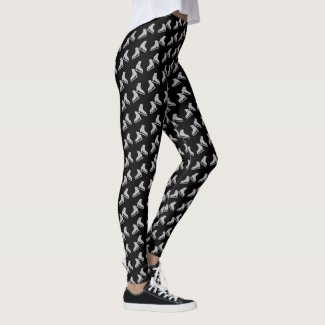
Figure skating leggings Ice skate pattern silver
Get the leggings
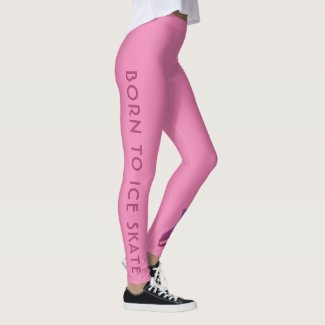
Pink figure skating leggings - Born to ice skate
Get the leggings
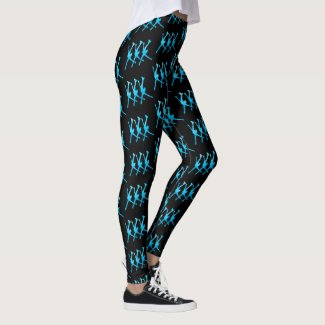
Synchronized skating leggings pattern turquoise
Get the leggings

See my whole collection of figure skating leggings

Don't miss the tips to take care of them at the end of the article!

Notes on plus size and dark skins tights

Let's be honest. Figure skating is sadly not the most inclusive sport there is.

When they create darker colors of tights, they tend to be more orangy.
There is starting to be movement to have more shades of skin, but progress is limited.
However for competition, you can buy normal pantyhose made of dark skin. They are not made for ice skating, but if you don't take something too thin, it should be good.

Same thing for plus size skaters, the current solution is to purchase classic tights or dance tights (some are developing plus size ranges). But they will be thin too.

Figure Skating Training journal Ad 1a
Figure Skating Training journal Ad 2

Why should you wear tights as a figure skater?

To better choose a pair of tights or leggings, one must first understand why figure skaters wear tights

1. To keep warm without hindering the movement

Well, that seems obvious but let's still state the fact: ice rinks are cold. You want to wear something on your legs to keep them warm.
However, you don't want to wear pants that would be bulky and maybe stiff. You want warmth but at the same time, something which will maintain your agility.

2. To protect your legs in case of falls

Well, figure skaters tend to fall a lot. Especially at practice when repeating news skills such as jumps or spins.
So you want something that protects a minimum against the impact and friction with the ice.
Plus you want a material that does not absorb too much the water, because it would get cold and be really uncomfortable.

3. For appearance

Finally, you want to wear something on the legs that is pretty and shows the beautiful lines created. It creates uniformity on the legs.
Something that does not hide the movements made by the legs.
Especially in competition, they can complement the costume for an overall impression.


Criteria to choose ice skating tights

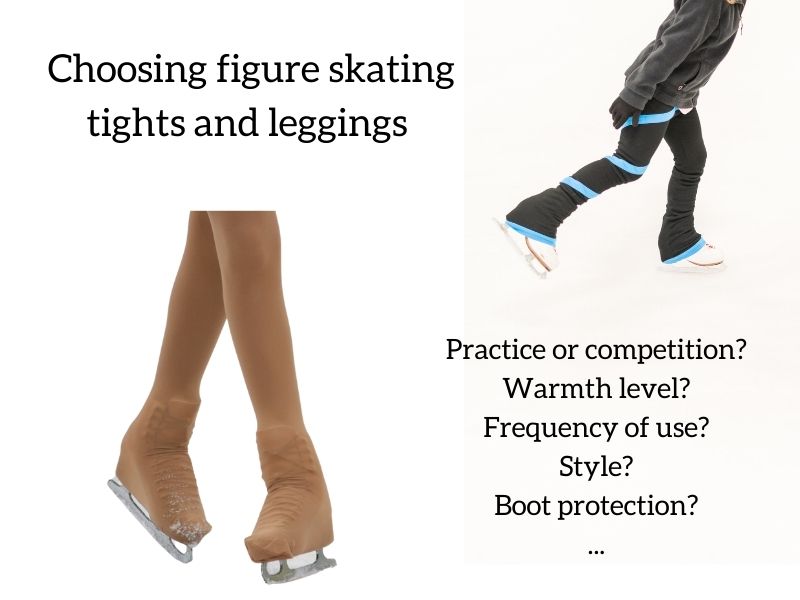
The questions to ask yourself

  • Will the tights be used in competition or at practice? 
  • How often with they be used?
  • Is the rink very cold or kind of warm? Yes, there are differences. I remember one rink where I had a yearly competition and we all had to wear 3 pairs of tights because it was so cold!!!
  • What is my style?
  • What will I wear with it - some wear just leggings, some have shorts over them, or a leotard with a small skirt...?

Your answers will help you choose the right tights for you based on the following criteria.

Figure skating tights

Color, thickness and texture

  • Figure skating tights are traditionally in skin color tones (though sometimes awkward orangy colors) - it is often not very easy to find a color that does not clash with the color of your arms and face, but it is getting better, I think.
  • You can find different textures that will catch the light in different ways and create different styles: smooth, sleek, transparent, with shimmer or thicker, matt, high shine... Some look more elegant while other blend better with your skin tone. The trends vary. Just choose what you prefer.
  • The thicker ones are often preferred for practice. They are normally matt.
  • You can find designs with rhinestones, but always read the comments to make sure they are well attached - you don't want them to drop on the ice and make someone fall!
  • However, practice leggings come in a variety of colors and designs

Material

You want the fabric to be

  • stretchable,
  • breathable (to allow sweat to pass through),
  • drying fast (in case your fall),
  • holding the shape around your leg (no sagging)

There are several materials used to manufacture figure skating tights:

  • nylon, polymer allowing for very thin garments
  • micro-fibers - they are considered high performance fibers for sport clothes (medium thickness)
  • bamboo - natural fiber, very breathable fabric (thicker tights)

To those, spandex, lycra or elastane are added, for their flexibility, elasticity and strength.

Design: Footed / Footless / Over the boot

You can find 3 different types of designs for figure skating tights:

  • Footless Design - often preferred for practice
    + you can choose your socks to wear in the skating boot, or to go barefoot
    + more resistant than the footed ones because they are less stretched by the foot movements and don't have friction in the boot
  • Footed tights - classic tights with a foot included
    + no need for socks
    + no seam at the ankle level where the boot rubs your skin the most
  • Over the boot tights - they attach under the boot with Velcro or hooks
    + create a beautiful line with the leg with one color, elongate the skater
    + protect your skating book from scratches (like boot covers, but looking less heavy)

There is no perfect option. There are trends. When I was skating competitively, over the boot were in fashion.
Just choose what you feel the most comfortable with what you find the most pleasant to look at.

Footless Tights

Footed tights

Over the Boot tights

Quality / brand / price

The 2 most famous brands for ice skating tights: Mondor and Capezio.
But they can become expensive for training.
Other good brands are also developing and trying to crack the market such as ChloeNoel (skating focus) and Body Wrappers (coming from dance)...

Make sure to read reviews for durability. But otherwise, this is your choice in terms of what you feel more comfortable in.

Tights can be expensive, especially if you wear them in training. This is why I recommend leggings for practice, as they will last longer.

For competitions, always bring back ups.

Figure Skating gift banner Zazzle 3
ice skating accessory gift banner
Figure skating notebook gift star ice pink
Figure skating leggings gift born to skate
Figure skating blade towel synchro blue arabesque gift
Personalize & Buy

Best tights for figure skating competition

What you want for competition tights

Well, the 2 main things you are looking for in competition tights are: COMFORT and APPEARANCE.
You need tights that:

  • don't annoy during any movements
  • make your leg look beautiful (length, color of your skin, over the boot or not, embellishment)
  • look good with your costume

Below are some good classic choices to consider if they fit your need.

Review of Mondor Classic figure skating tights over the boot

Features

  • Over the boot design
  • Thin for beautiful leg (70 denier in nylon)
  • Spandex for elasticity
  • Matte finish
  • Clips under the boot

Cons

  • As they are thin beautiful tights for competition, they are more fragile

Buy on Amazon / Read reviews

Review of ChloeNoel over the boot figure skating tights

Features

  • Over the boot design
  • Lycra for elasticity
  • Matte finish
  • Medium weight
  • 70 denier in nylon
  • Clips under the boot
  • Different designs with embellishments or not

Cons

  • As they are thin beautiful tights for competition, they are more fragile

Check out the various colors and rhinestone designs / Read reviews

Review of Mondor classic footed tights with shimmer

Features

  • Footed
  • Elastane for elasticity
  • 40 denier in nylon
  • Shimmer / shiny finish

Cons

  • As they are thin beautiful tights for competition, they are more fragile

Buy on Amazon / Read reviews


Best figure skater leggings for practice

What you want for practice tights or leggings

Well, the 4 main things you are looking for in practice tights are: COMFORT, WARMTH, DURABILITY and APPEARANCE.
You need tights that:

  • don't annoy during any movements
  • keep you warm, however long your stay at practice
  • are strong enough to withstand the falls, the moves, the frictions... for many practices
  • show your personality

So, here are some options that could be good:

Review of 

Features

  • Footless
  • Heavy weight to keep warm
  • Satin effect
  • Cotton, Nylon and Lycra

Cons

  • Still see through, you have to wear shorts or a skirt above.

Buy on Amazon (See colors) / Read reviews

Review of 

Features

  • Footless
  • Several colors and designs
  • Goes over the boot for longer legs appearance
  • Quick drying
  • Fleece to keep warm

Cons

  • Be careful what you wash them with to avoid damage to the fabric

Check out colors / Read reviews

Review of 

Classic for practice - solid and comfortable

Features

  • Footless
  • Classic black 
  • Supplex and Lycra mix
  • Heavy weight to keep warm

Cons

  • No designs or colors to show personality

Buy on Amazon / Read reviews

The ice skating passion collection of leggings

But if you want something a little different, to stand out on the ice at practice, check out my collection of leggings with figure skating designs and synchronized skating designs.
Features

  • Spandex blend
  • Medium weight
  • Sturdy, don't lose shape
  • Breathable

Cons

  • Not a specific shape for figure skating (does not go over the boot)
  • Not as warm as heavy weight - so it depends how cold you feel when practicing (however, you can also show your passion outside the rink!)
Figure skating leggings Ice skate pattern silver
Get the leggings
Pink figure skating leggings - Born to ice skate
Get the leggings
Synchronized skating leggings pattern turquoise
Get the leggings

See my whole collection of figure skating leggings


6 Tips to take care of your tights

Below are a few tips to

  • Make your tights last longer
  • Keep your tights in good shape
  • Manage damage to your tights

#1 Don't leave them in your bag

This is an obvious one, but life gets busy, and things get missed...
After practice or competition, tights should at least be dried out outside of the bag. Sweat and ice have most probably accumulated on them.

#2 Washing

Prefer washing your tights by hand with a gentle detergent or simply a Marseille soap. 
Don't use too hot water (as they could shrink).
Some add fabric softener (so that they remain softer when drying) but I think that the less chemicals, the better.

#3 Drying

Do not place them directly on a radiator, set them up on a chair or on a drying laundry rack facing a radiator.

#4 Don't shove them in your bag

Many things in your bag can get caught in your tights and rip them (zipper, hooks...). So never just shove your tights in your ice skating bag.
Keep them in their original bag, or place them in a tote bag to protect them

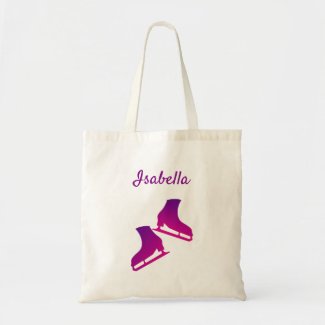
Ice skating tote bag figure skates purple pink
Personalize it
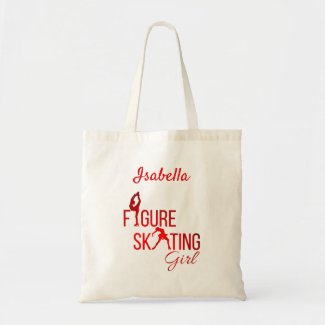
Tote bag Figure skating girl red
Personalize it
Ice skating tote bag Pink sparkle best feeling
Personalize it

#5 Always carry clear nail varnish

When going to competition, your emergency kit in your competition equipment bag should contain clear nail varnish.
If you have a hole and no time to change tights, apply a coat of varnish all around the hole to stop it from getting bigger during your performance. It creates a crust.
Same if a ladder has started. Apply varnish at both ends.
And don't worry, it has happened to all skaters, this is not dramatic 🙂

Get it on Amazon

Get safety pins

#6 Carry safety pins

If you have opted for over-the-boot tights, make sure you also carry safety pins in your bags.
I had that happen too when the Velcro or the hook under the boot broke. You still need you boot cover to attached under it. Safety pins are you saviors. 

Figure Skating gift banner Zazzle 3
ice skating accessory gift banner
Figure Skate blade Towel Axel in life pink glam
Ice skating pillow - Pink Born to ice skate
Ice skating notebook live on edge blue silver
Personalize & Buy

Share0
Tweet0
Pin0

You might also be interested in:
The 5 Figure Skating Olympic Events

Figure Skating Competition Checklist (to-do + packing)

Best synthetic ice for figure skating (+ is it a good idea?)

best figure skating tights leggings Pin1
best figure skating leggings tights Pin2

10 best off-ice hockey training equipment

Last updated on April 23, 2021

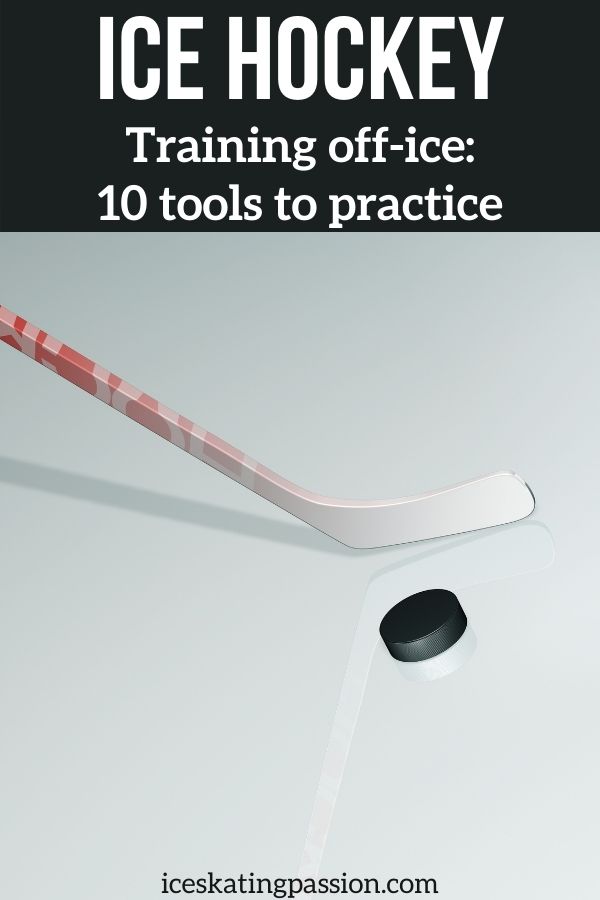
Time on the ice is limited. To become a better hockey player, you must add exercise routines outside the rink. Below are my top 10 selection of off-ice hockey training equipment to help you improve your performance in terms of balance, power, hand-eye coordination, reflexes...

This article does not list the typical weights to list and home gym equipment, I guess you know all these already.

off ice hockey training equipment Pin1

Table Of Contents
Choose your figure skating off-ice training equipment
#1 Slide Board 
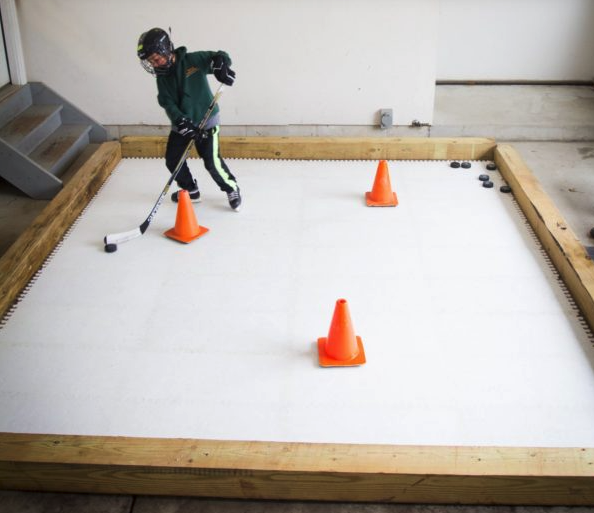
#2 Hockey Shooting Pads / Floor Tiles
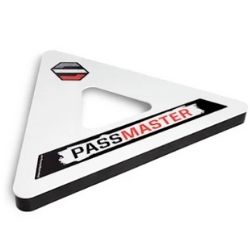
#3 Pass Master / Rebounding trainer
#4 Stick Handling Training Aid
#5 Goal & Goalie Shooter Tutor
#6 Drill Set - trick hot kit
#7 Balance Board Trainer
#8 Jump Box
#9 Sliding Discs
#10 Book for Mental Strength

This article may contain affiliate Links (info on the Disclosure page). If you purchase using my link, I get a commission at no extra cost to you.


Choose your figure skating off-ice training equipment

What must hockey player work on, when off the ice?

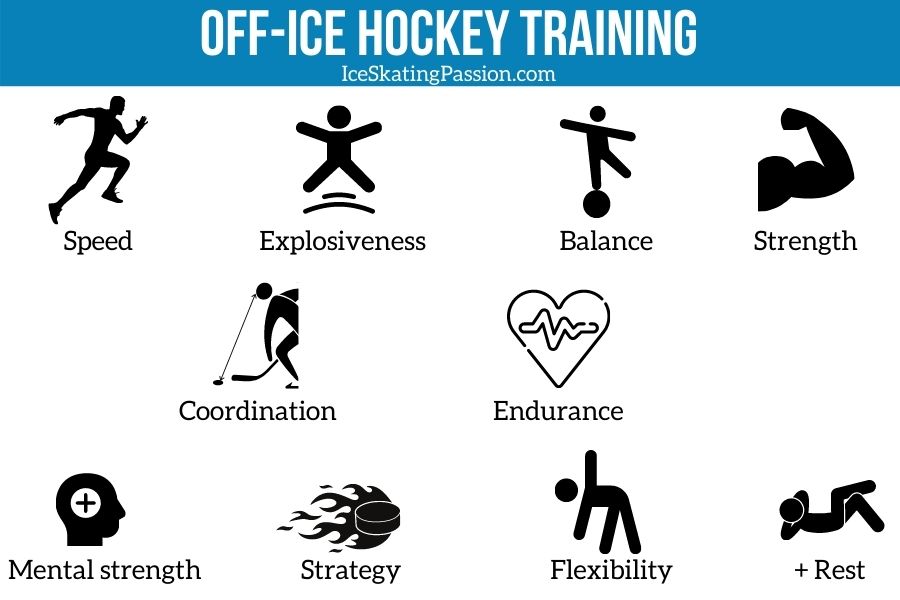
There are 9 types of training a hockey player should be focusing on, when working our off-ice:  

  • Speed
  • Balance
  • Explosiveness 
  • Endurance
  • Strength
  • Coordination
  • Mental strength
  • Strategy
  • Flexibility

Learn more about each of them in my off-ice hockey training introduction article.

off ice hockey training workout what to do

How to work on them?

All of them can be worked on without any equipment with exercises using only the weight of the body.
However, using specialized equipment can bring a lot to the off-ice training routine:

  • Variety of exercises
  • Types of exercises mimicking the hockey moves (not possible without any accessories) - spinning, sliding, gliding, mastering the puck...
  • Increase the intensity of an exercise

Therefore, I have collected for you 10 of the best pieces of equipment to help you train off-ice. They can be great gifts for hockey players.

Note: always check out with a doctor or physiotherapist before practicing physical activities - and if you are a parent, always supervise off-ice training of the younger ones.

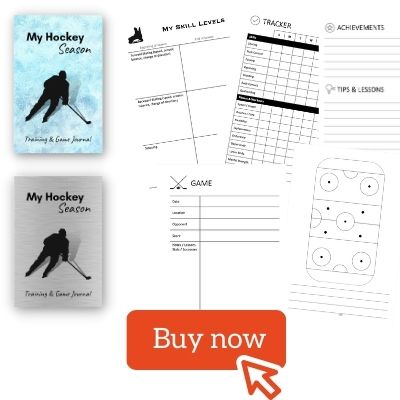
And if you want to take notes and see your progress, check out my specialized journal:

Season Hockey Training Log notebook
Season Hockey Training journal notebook

#1 Slide Board 

What you work on

  • Endurance - high intensity exercise low impact
  • Balance - some exercises are focusing on balance and stability
  • Explosiveness / power

Get a first price option with good reviews

Get an adjustable option

How it helps your hockey skills

  • Practicing on a sliding board is the closest to skating you can get, at home, to performing the skating stride
  • It will improve your endurance with the lower body flexion, as if you are skating around the rink
  • It will work your core muscles to improve balance - this is essential to all aspects of ice hockey: skating fast, avoiding the opponent, 

How to choose

  • First, check out the size of the slide - you need longer ones for taller players, otherwise it will get frustrating
  • Check out the comments for the sliding factor - depending on materials some cheaper ones may not slide as well
  • If you want more flexibility, check out the adjustable versions with tiles instead of single mat
  • Learn more on my article about the best slide boards for hockey training

#2 Hockey Shooting Pads / Floor Tiles

What you work on

  • Hand-eye coordination - as you master the glide of the puck
  • Reflexes - especially if playing with someone else or with a pass master
  • Stick handling techniques

Get the pad / Read reviews

Get the tiles / read reviews

How it helps your hockey skills

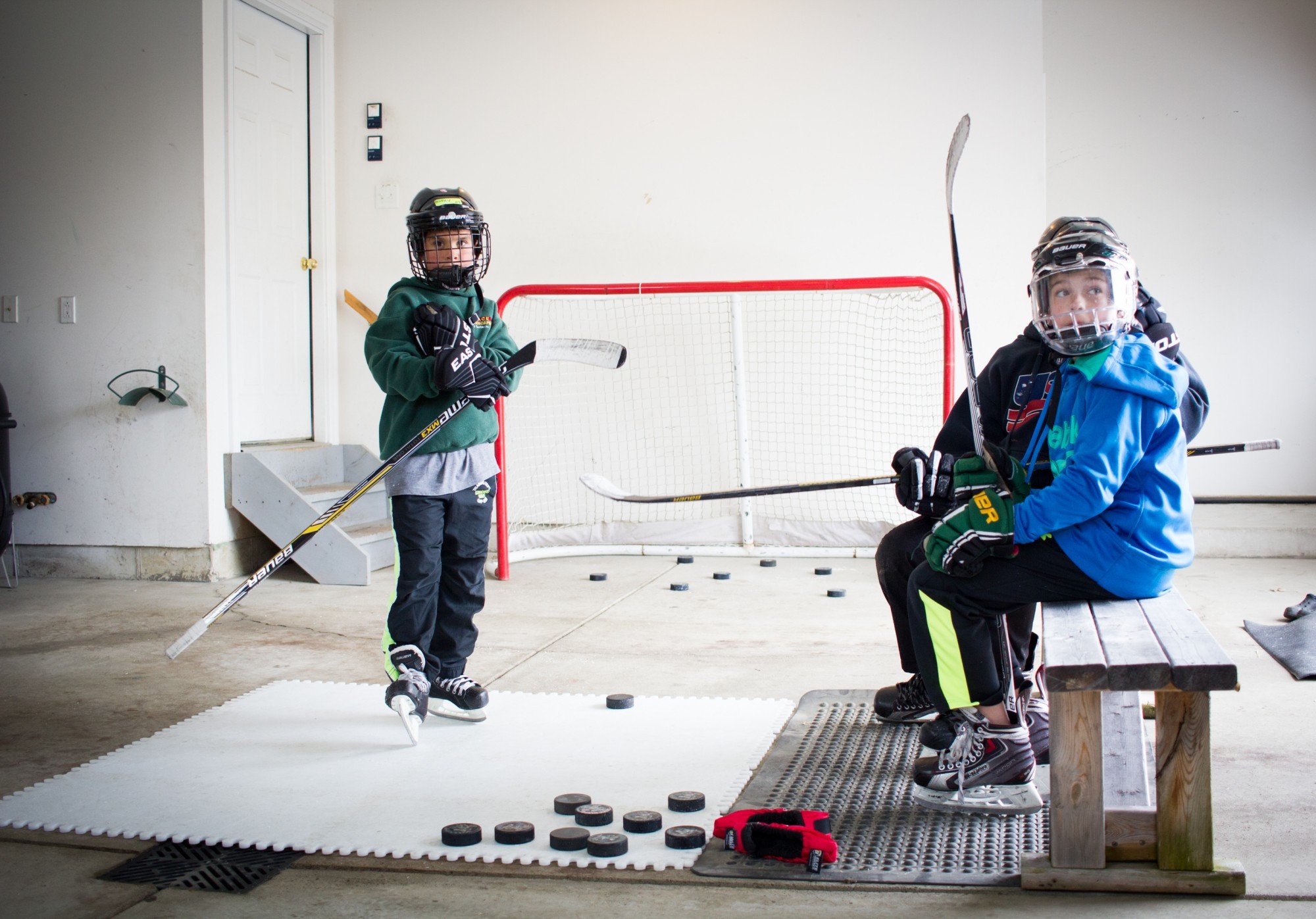
  • Well, this is what mimics best the movement of the puck on the ice. It allows you to practice your techniques and drills on the ice, even if you can't be at the rink
  • You can work on moving the stick around the puck - controlling its position and direction
  • You can work on catching the puck
  • And combined with the following equipment, you can practice shooting.
  • Note - if playing on shooting pads with friends, don't forget your mouthguard (the puck can go fast and stick can go up!)
  • And don't forget to wear your hockey gloves, to imitate on-ice practice!

How to choose

  • Portability vs size - depending on what you want to work on and how (fixed in a room or moving to outside), you can choose what is best adapted
  • Check reviews for the quality of the surface and how it slides
  • Check reviews for durability
  • Learn more on my article about the best hockey shooting pads and tiles

Looking for something even more advance to even skate off-ice?

Check out the Skate Anytime impressive synthetic ice:

best Synthetic ice skate anytime starter kit

Buy 8 panel - starter kit

Best synthetic ice panels skate anytipme deluxe starter kit

Buy 20 panel - Deluxe starter kit

Or you can read my article about the best synthetic ice tiles for for hockey.


#3 Pass Master / Rebounding trainer

What you work on

  • Hand-eye coordination and
  • Reflexes - as the pucks rebound and imitates having another player
  • To practice passing the puck
sniper edge pass master training aid pure hockey

Get the Passmaster

Get the rebounding training

How it helps your hockey skills

  • This is to use in combination of the shooting pad or tiles (if not included in a kit)
  • Training alone on the shooting pad has limits. The pass master or rebounding training equipment helps mimic having another player react to your moves.
  • This type of equipment requires you to be precise in where you are shooting and reactive as it come back to you

How to choose

  • Check on which surfaces you can use it and how well it holds
  • Check reviews for durability
  • Check size for your level
  • See my article about the best passers rebounders of all shapes
ice hockey gift banner
Figure Skating gift banner Zazzle 3
Ice hockey player - sticker (black)
Ice Hockey t-shirt Favorite season fan blue
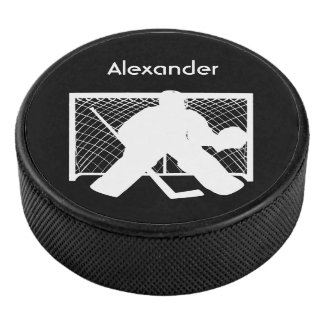
Ice hockey puck goalie silhouette black white
BUY +  PERSONALIZE

#4 Stick Handling Training Aid

What you work on

  • Hand-eye coordination - This is perfect to have the puck go in many directions as well as abruptly change direction... you get to react with your stick to catch it
  • Reflexes - To master fast passing techniques
  • Stickhandling techniques

Get it / read reviews

Get 8 sections of Stickhandling trainer / read reviews

How it helps your hockey skills

  • In ice hockey, the puck can be coming from anywhere. The pace is very fast, and you must be ready to detect the puck and react very fast. As you are alone it can be difficult to practice. This tool helps mimic receiving passes from all directions.
  • And you also use it to master your control of the puck as you move around it
  • And you can also use them on the ice if you have a solid frozen pond nearby!

How to choose

  • Check out its versatility - how can you combine the legs, what shapes you can create, so that you can vary your training and practice more potential moves
  • Check reviews for durability
  • Learn more on my article about the best hockeys stick handling tools and trainers

And don't forget to hydrate as you train:

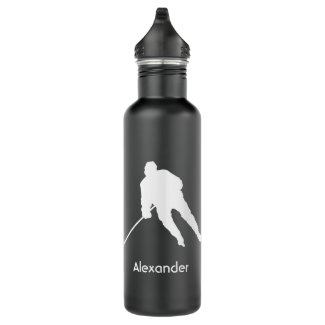
Ice Hockey water bottle player name black white
Personalize this bottle
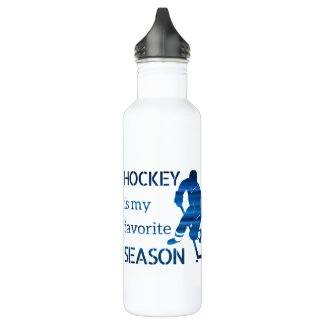
Hockey Water Bottle Favorite Season blue lines
Personalize this bottle
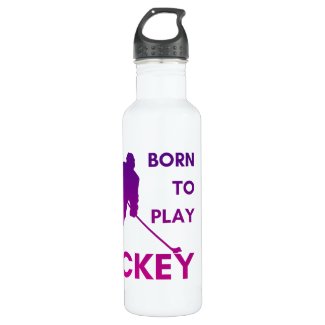
Ice hockey water bottle girly purple born to play
Personalize this bottle

#5 Goal & Goalie Shooter Tutor

What you work on

  • Hand-eye coordination - You need to use your stick appropriately to pass the goalkeeper
  • Endurance - if you work on them repetitively
  • Shooting techniques
  • Shooting accuracy

Read reviews and buy on Amazon 

or Read reviews & Buy green or orange on Pure hockey

Buy / Read reviews

Buy it / Read reviews

Get it on Amazon

How it helps your hockey skills

  • Well, the goal of hockey is to shoot the puck past the goalie... so when you don't have someone to play the goalie at home, this is the next best thing!

How to choose

  • Good size for the size of your goal
  • Waterproof if you want to use it outside
  • Careful, most fake goalies should not be used with full weight pucks as they can destroyed them quickly
  • Learn more on my article about the best targets, shooter tutors and shooting tarps
ice hockey gift banner
Figure Skating gift banner Zazzle 3
Ice hockey blade absorbent towel born to play blue
Ice hockey notebook goalie red
Rather be playing - Speed blue hockey player T-Shirt
BUY +  PERSONALIZE

#6 Drill Set - trick hot kit

What you work on

  • Hand-eye coordination - for accuracy shooting
  • Plus, it is a wonderful game to play at a party with people from all levels (even beginners). It is often a big hit

Get it on Amazon

How it helps your hockey skills

  • It is more sold as a game, but you can really work on your accuracy with the small net
  • You can vary your exercise by placing it in various locations: for example, up a staircase
  • Plus, you can take it anywhere!

#7 Balance Board Trainer

What you work on

  • Balance
  • Coordination and agility
  • To be able to move fast on the ice and react to the position of other hockey players

Buy the roller balance board / Read reviews

Buy the wobble board / Read reviews

How it helps your hockey skills

  • You will be building on core strength to improve balance on your ice skates
  • You will have to coordinate all your muscles to keep balance and maybe do tricks
  • This is needed to be able to move fast on the ice and avoid all the other players by changing your point of balance quickly

How to choose

  • Good size for your feet
  • The 2 best types of hockey players are Roller board or wobble board
  • Check the weight limit
  • Make sure it has a good grip surface
  • Learn more on my article about the best balance boards for hockey training

#8 Jump Box

What you work on

  • Explosiveness / power - as you push to reach the top of the cube

Get it on Amazon

How it helps your hockey skills

  • Pushing on the ice requires a lot of explosiveness to improve performance - you need to be able to accelerate and change direction very fast. Making your muscles able to power up very quickly is essential. Repetitive jumps on such a box helps.

How to choose

  • Check the material - you want something of good quality with anti-slip system 
  • Choose a box that allows you to evolve and increase difficulty (different sizes on each side)
  • Check reviews for durability and stability of the box

#9 Sliding Discs

What you work on

To increase core training

  • Balance - these discs are good to increase the intensity of your core strength exercises.
  • Reflexes - there is always a movement and your body must adjust quickly as soon as it slides.

Get them on Amazon

How it helps your hockey skills

  • It helps with all aspects of ice hockey as you will be increasing your workout on core strength and flexibility
  • Better control of skating, turns, avoidance moves and body position for shooting

How to choose

  • Check diameter is sufficient for your hand size
  • Check out reviews for durability

#10 Book for Mental Strength

What you work on

  • Mental strength

How it helps your hockey skills

It is often easier to work on the body than on the mind. But a strong mental state is also key for success as a hockey player.
The list is long. You can:

  • Read about techniques and stories of great athletes - Read the many books focused on Athlete mentality
  • Understand mindfulness
  • Focus on positive thinking
  • Enjoy visualization
  • Practice meditation
  • ...
  • and check out my selection of 35 ice hockey quotes.

Read it

Read it

Read it

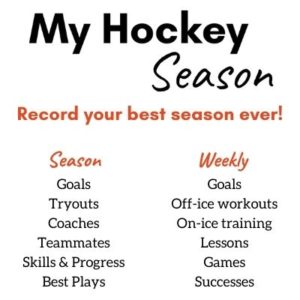
Take notes about the best plays:

See special rink interior / Buy it


Share0
Tweet0
Pin0

You might also be interested in:

How to clean hockey equipment (at home)

15 ice hockey themed wedding ideas

14 best Hockey Shoulder Pads (in 2022)

12 Best hockey elbow pads (2022) – youth, junior, senior

off ice hockey training tool Pin2
off ice hockey practice equipment Pin1

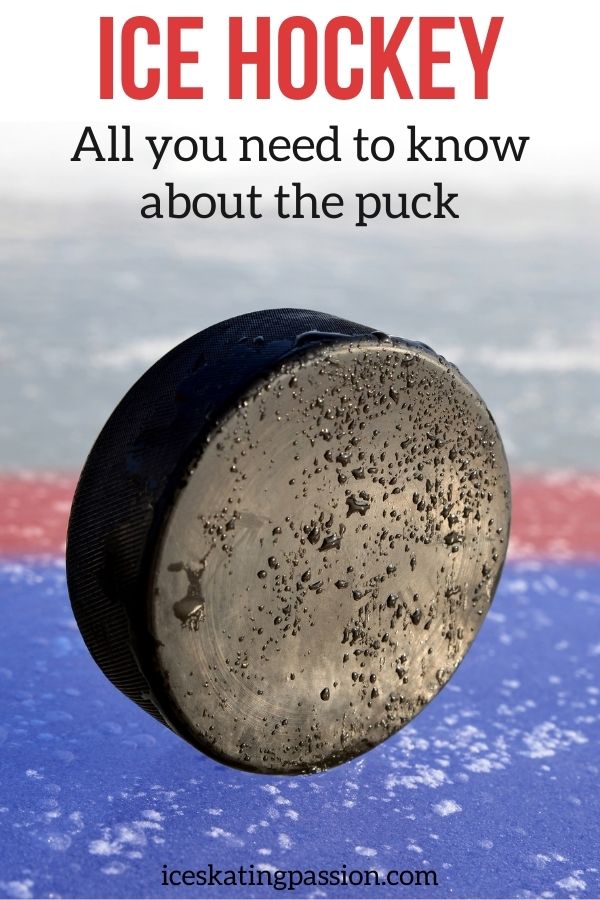
The Ice Hockey Puck (facts, history, dimensions…)

Last updated on October 1, 2021

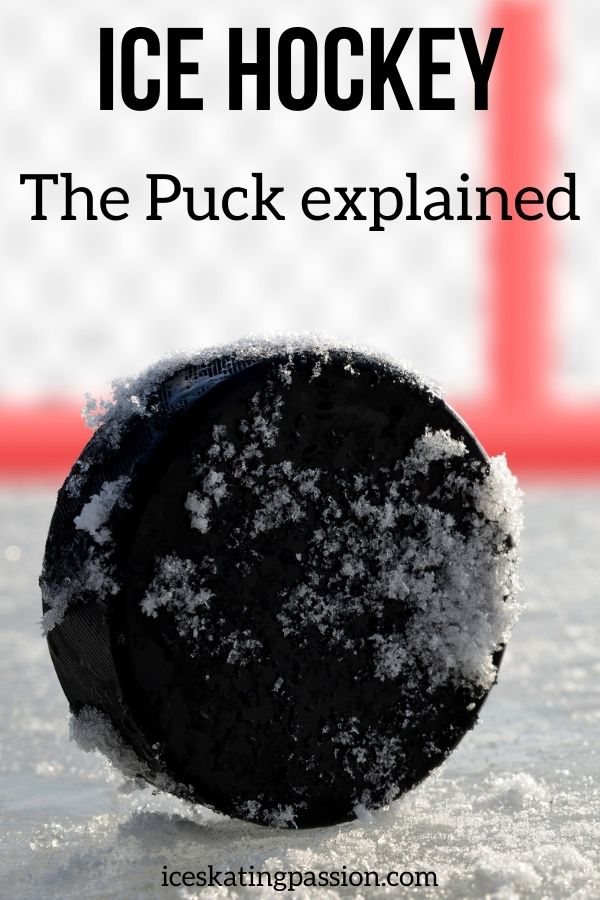
This tiny black piece of rubber can go so fast and make people crazy... the answer is the hockey puck! 
Below is an article to learn about it:

  • the first hockey puck,
  • the hockey puck history,
  • fun hockey puck facts,
  • dimensions, weight,
  • speed,
  • how it's made,
  • and much more...
ice hockey puck facts history dimensions

Table of Contents
Ice Hockey Puck history
Making a Hockey puck - dimensions, material...
How are regulation pucks made?
Interesting facts about the hockey puck / trivia
About the word puck
Hockey pucks gifts - personalized or NHL

This article contains affiliate links. If you purchase using my link, I get a commission at no extra cost to you (learn more).


Ice Hockey Puck history

If you’ve ever watched an ice hockey game then you know there’s no ball.
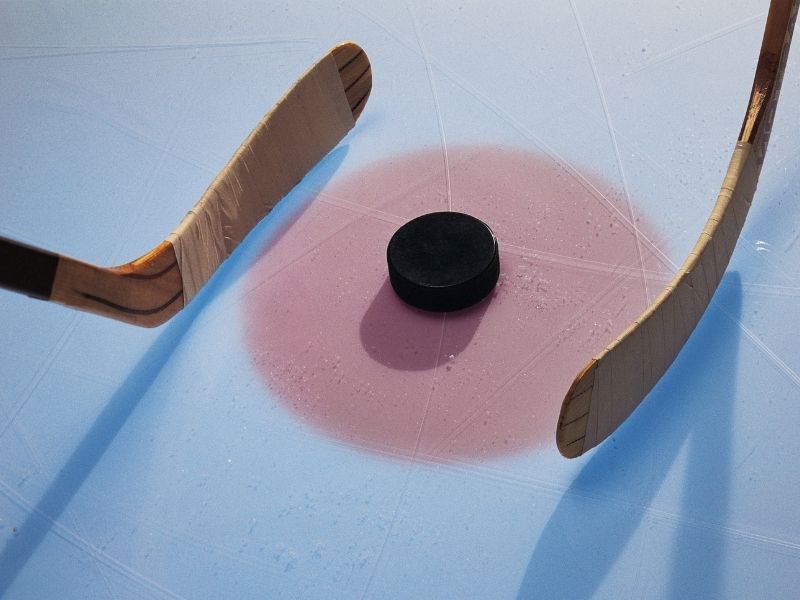
Ice hockey uses a strange little black object. It is called a puck (see further in the article to understand the name).
Hockey players fight for it, handle it with sticks and try to get it across the rink into the net, past the goalie.

But how did we end up playing hockey like this? 

hockey puck facts in games

What did hockey players use before the puck?

According to legends, the first hockey players were playing with pieces of frozen cow dung as pucks. However, there is no proof.
Other early versions were probably made out of pieces of wood and stones.

The first ice hockey puck: who invented it?

The first officially recorded pucks were lacrosse rubber balls of which the rounded edges were cut. This puck was square.
It is believed to have been first recorded in 1875 (during the first official hockey match), in 1876 or 1886 depending on the sources... One says that it was first recorded in print on 7th February 1876 in the Montreal gazette.

In the late 1800' and early 1900's, they tried improving it to make it slide on the ice. Rubber was used as a coating.
Some were 2 pieces of rubber glued together, but they did not last long.

Finally, a new method was developed in Europe to create flat balls: a flat piece of wood with a coat of vulcanized rubber.
It is believed to have been the inspiration for the modern sport. However, there are no pictures or evidences.

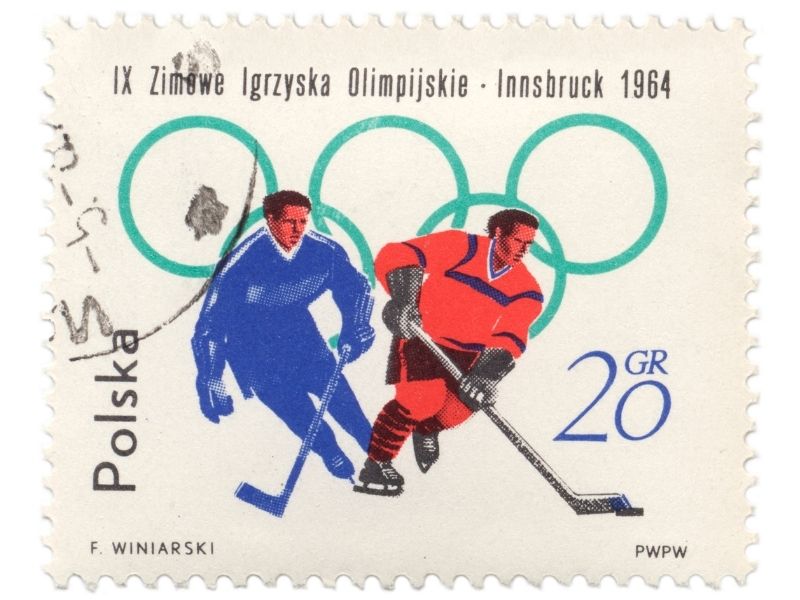
hockey puck history old stamp yay

Evolution of the hockey puck - standardization and the Foxtrack

The modern puck design dates back to around 1940. Pucks were then made in factories. It was a mix of rubber and bonding materials as well as carbon black. The mix was shaped, cut and cured in an oven. Therefore, they were kind of standardized for consistent play and to facilitate the manufacturing.

The NHL standardised the puck to be used for the league in the early 1990's.

At the same time, television wanted to improve the visibility of the puck. 
The first trial was the Firepuck with reflective materials, but it stopped being used.

In 1995/96, the "Fox track smart puck" was developed. It contains electronics to track its position, allowing the tv to trace the path across the ice with a blue halo (or red/green when shot at different speeds). The viewer could track the movement of the puck more easily.
Fox television started using them in 1996.

Season Hockey Training Log notebook
Season Hockey Training journal notebook

Making a Hockey puck - dimensions, material...

Material - what is a hockey puck made of?

Have you ever watched a game and wondered what a hockey puck is made of? Well....

Hockey pucks are all made of vulcanized rubber (similar to tires). This material:

  • can slide fast on the ice (it is very dense)
  • can withstand shots without damaging
  • is bouncy at normal temperature but does not bounce when cooled down

Vulcanization is a chemical treatment. Sulfur or other chemicals are used to alter the physical properties of rubber. This way you keep the positive: the resistance to rust, corrosion and elasticity, but you fix the softness and elasticity of the unmodified rubber. Learn more about vulcanization here.

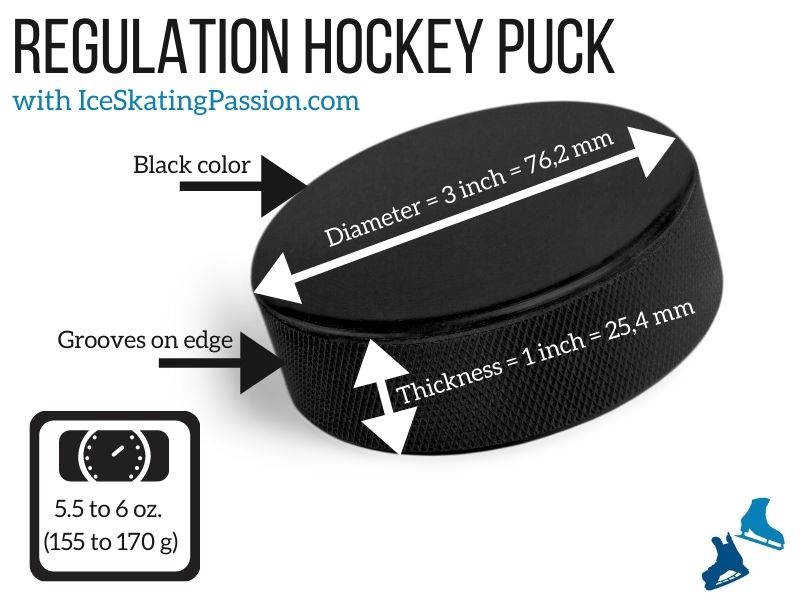
Regulation hockey puck dimensions facts

Hockey puck dimensions & weight

Since the 1990s, the NHL has defined standardized dimensions for the puck (and they are listed in the USA rule book - rule 306):

  • Color = black
  • Thickness = 1 inch = 25,4 mm
  • Diameter = 3 inches = 76,2 mm
  • Weight = between 5.5 and 6 ounces (155 to 170 grams)
  • Edge texture = grooves carved into the surface (for the hockey stick to have something to grab)

Other sizes and weight can be used for 

  • children's hockey leagues (4 to 4,5 ounces = 113g -128 grams blue)
  • for strength training (up to 10 ounces = 283 grams - sometimes red)

Practice or decorative pucks can be found with logos and in other colors.

Figure Skating gift banner Zazzle 3
ice hockey accessory gift banner
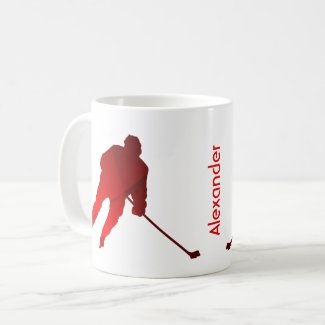
Ice Hockey mug player silhouette red
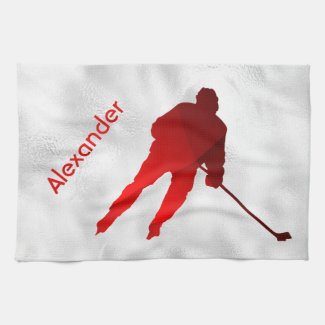
Ice Hockey skate towel player red
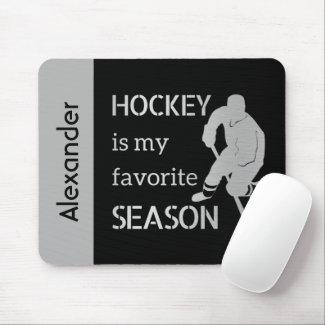
Ice Hockey mouse pad favorite season silver
BUY +  PERSONALIZE

How are regulation pucks made?

Who makes hockey pucks?

NHL games hockey puck can only be made by approved manufacturers.
So far, the major manufacturers have been approved in:  USA, Canada, Russia, China, Czech Republic and Slovakia.
The famous puck brands are:
  • Spalding (USA)
  • Viceroy (Canada)
  • Sher-Wood (Canada)
  • InGlasCo (Canada) - official supplier to the NHL as of 2021
who makes hockey puck canada

Manufacturing process

The main steps are:
  1. Mixing the granular rubber with the bonding material + antioxidants + coal dust
  2. Shape into a circular log that is 3 inches in diameter
  3. Cut into one inch pieces
  4. Place the piece of rubber into a mold 
  5. Compress at room temperature
  6. Silk-screen any logos or designs with rubber-based ink

Inspection

Official pucks are inspected to make sure that:

  • they are compliant in size and weight. 
  • There is no soft rubber
  • There are no air bubbles
  • They do not bounce after 10 days of freezing

Pucks that fail are recycled.

Hockey Playbook

Interesting facts about the hockey puck / trivia

Average speed of the hockey puck

During a hockey game, a puck generally reaches speed of 100 miles per hours (161 km/h).

The official Guiness World record is at 110.3 miles per hour (177.5 km/h) by Denis Kulyash on February 2011

However, recordings that are official or not have shown speeds of 114 and even 118 mph.

They go really fast! Which is why protective equipment, including mouthguards, are essentials.

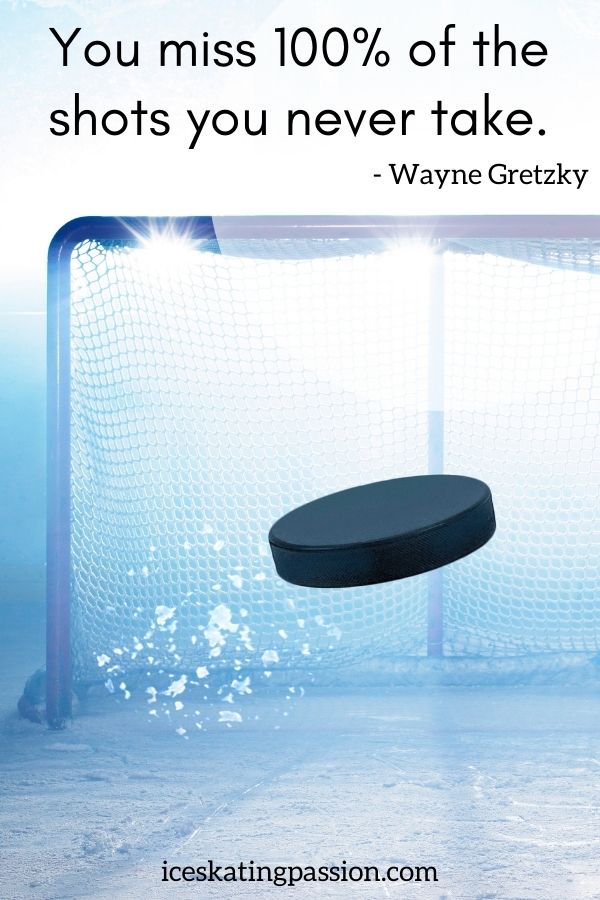
Inspiration ice hockey quote - Wayne Gretzky - miss shots never take

See more hockey quotes

Pucks are frozen before a hockey game

For NHL games, pucks have to be stored at 14°F (-10°C) before being used in a game.
As discussed in the description before, the rubber is bouncy. By freezing it, it prevents the bounce and they become easier to control.
They are stored in a freezer. Pucks are rotated.

How many pucks are used during an NHL game?

To keep that temperature, pucks must be changed regularly with fresh ones from the freezer.
An average NHL game uses over a dozen pucks, sometimes a lot more.

New technology makes the lettering change color based on temperature. This alerts the officials that it is time to change the puck.

Fun fact

Sometimes the puck flies and ends up in strange places! This was the case of Alexander Wennberg, a Swedish player. The puck got lodged in his trousers, so he skated to the goal and squatted to make it fall (the use of hands is not allowed). The goal actually counted.

Figure Skating gift banner Zazzle 3
ice hockey accessory gift banner
Ice hockey blade absorbent towel born to play blue
Ice Hockey Notebook (red skate with hockey words)
Rather be playing - Speed blue hockey player T-Shirt
BUY +  PERSONALIZE

About the word puck

Why is it called a puck?

The origin of the work puck is not clear. (oxford states "unknown origin")
The various suggestions are:

  • from the Scottish Gaelic puc or the Irish poc, meaning "to poke, punch or deliver a blow" 
  • from the old English word "pouke" which means “devil,” “evil spirit,” - note; the “Puck” was a mischievous Satyre spirit in Shakespeare’s “A Midsummer Night’s Dream". He was constantly “poking people the wrong way.”
  • From the Irish settled in Halifax, Canada who were playing hurling in which the verb to puck was used

A hockey puck is also referred to as a "biscuit". 

Hockey puck in other languages - how is it called

  • in French = Palet (in France) or Rondelle (in Canada) - the name has its origin in the shape of the puck
  • In German = Eishockey-Puck
  • In Russian = хоккейная шайба ("khokkeynaya shayba")
  • in Finnish = kiekko
  • In Swedish = hockey puck

Hockey pucks gifts - personalized or NHL

Personalized hockey pucks

To play, practice or decorate a room, you can choose a hockey puck to personalize (other colors in my shop).
It makes a great gift for a hockey fan or a hockey player gift.

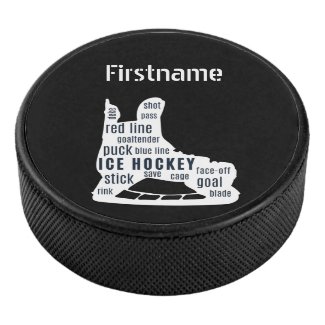
Hockey skate words - Black Personalized Ice Hockey Puck
Personalize the Puck
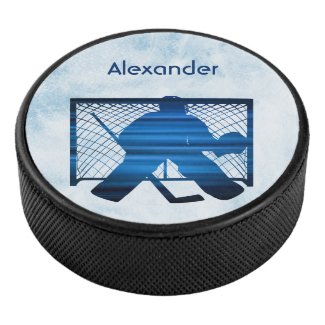
Ice hockey puck goalie silhouette blue
Personalize the Puck
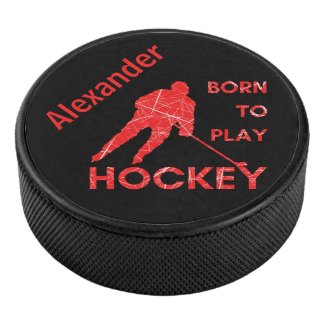
Hockey player puck Born to play red ice name
Personalize the Puck
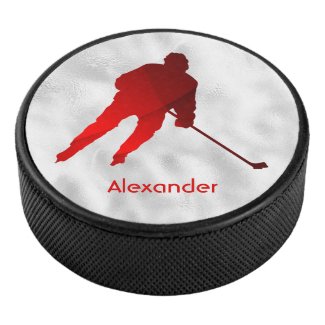
Ice Hockey puck player silhouette red
Personalize this puck
Ice Hockey puck favorite season turquoise blue ice
Personalize the Puck
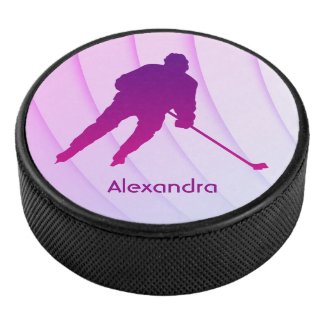
Ice Hockey puck player silhouette purple
Personalize the Puck

NHL team hockey pucks

And if you know someone who is fan of a specific hockey team, you can also offer the NHL official team hockey puck. See all the available teams HERE.

Get the Pittsburgh Penguins puck

Get it the Detroit Red Wings puck

Get the New York Rangers puck

You can practice handling pucks at home. Check out my tips on choosing your hockey shooting pad.


Complete your hockey equipment set!

Other protective gear to get for hockey players:

  • Best hockey helmets - read article
  • Best hockey gloves for players - read article
  • Best hockey mouthguard - read article
  • Best hockey shin guards - read article
  • Best hockey elbow pads - read article
  • Best hockey shoulder pads - read article

And if you want to work out off ice:

  • 10 essential elements to cover in your off-ice workouts - read article
  • 10 best off-ice hockey training equipment - read article
  • Best hockey shooting pads and tiles - read article
  • Best slide boards for hockey training - read article
  • Best synthetic ice for hockey players - read article
  • Best net targets and shooting tarps - read article
  • Best hockey passers and rebounders - read article
  • Best balance boards for hockey players - read article
  • Best stick handling tools - read article

ice hockey puck domensions facts history Pin1
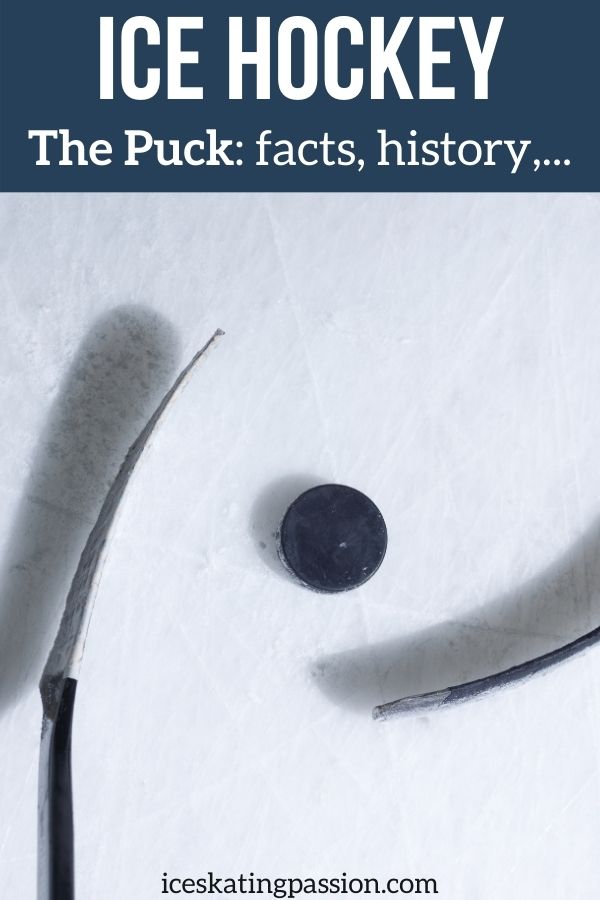
ice hockey puck history history dimensions facts Pin2
  • « Go to Previous Page
  • Go to page 1
  • Interim pages omitted …
  • Go to page 7
  • Go to page 8
  • Go to page 9
  • Go to page 10
  • Go to page 11
  • Interim pages omitted …
  • Go to page 19
  • Go to Next Page »

Footer

As an Amazon Associate I earn from qualifying purchases. IceSkatingPassion.com is a participant in the Amazon Services LLC Associates Program, an affiliate advertising program designed to provide a means for sites to earn advertising fees by advertising and linking to Amazon.com, Amazon.uk and Amazon.ca

Disclosure / Terms of use / Privacy Policy

Site en Français

Copyright © 2026 IceSkatingPassion.com · Log in

If you continue browsing this site we assume you agree with the use of cookies in this website.